
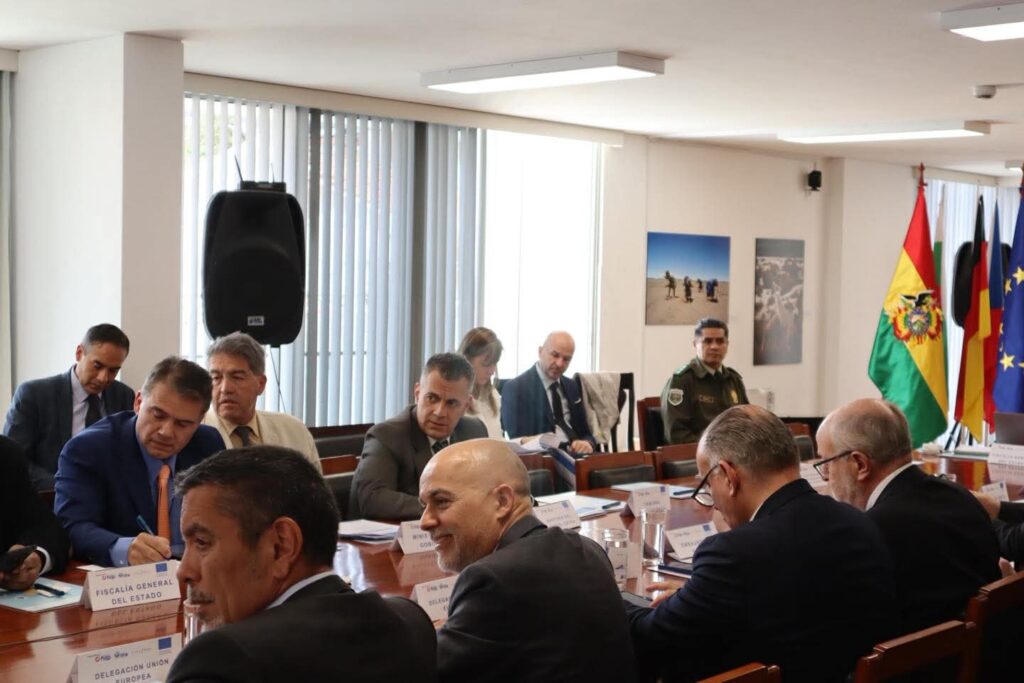
During the meeting, authorities presented the 2025 results and formally approved the 2026 operational planning, placing strategic emphasis on enhancing criminal intelligence capabilities, improving interagency coordination among the Police, the Public Prosecutor’s Office, and the Judiciary, and strengthening international cooperation mechanisms. The initiative signals a structural approach that goes beyond tactical operations, aiming instead at reinforcing Bolivia’s justice system as a whole.
A central component of the program includes the promotion of Joint Investigation Teams (JITs), aligned with European cooperation frameworks such as EL PACCTO 2.0 and EUROJUST. This integration places Bolivia within a broader transnational legal and operational network designed to address organized crime, drug trafficking, financial crimes, and illicit flows that transcend national borders.
The EU’s continued engagement also supports Bolivia’s forthcoming National Strategy Against Illicit Drug Trafficking (2026–2030), demonstrating policy alignment between domestic anti-narcotics planning and international cooperation standards. The involvement of specialized European partners — including FIAP (Spain), CIVIPOL (France), and IILA (Italy) — underscores a high-level technical and diplomatic commitment.
Beyond technical assistance, the initiative carries geopolitical significance. It reflects the European Union’s recognition of Bolivia as a strategic partner in regional security architecture, while reinforcing democratic governance, institutional resilience, and the rule of law in a context where organized crime increasingly challenges state structures worldwide.
By: Editorial Team


About Author
